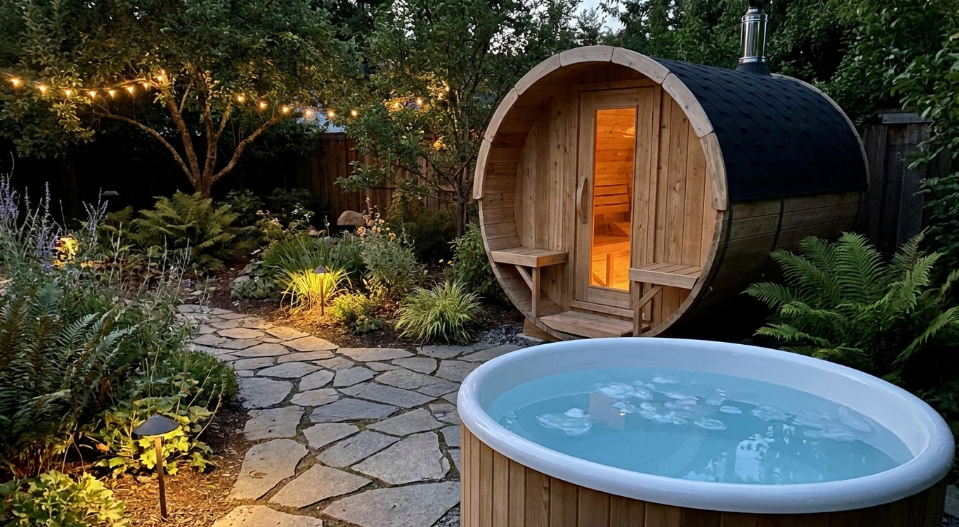
The cardiovascular research behind sauna bathing does not separate wood-fired heat from electric heat, so neither one has a documented health edge over the other. What actually differs is installation, running cost, and how each heater sits inside a curved barrel cabin: wood needs a roof-penetrating chimney and firewood, electric needs a proper circuit and a power bill. The right choice comes down to your site, your budget, and how much you want fire-tending to be part of the ritual.
What the Evidence Actually Says About Sauna Heat
The research most often cited for sauna’s cardiovascular associations, including large Finnish cohort work summarized in Mayo Clinic Proceedings, studies sauna bathing broadly, meaning hot-air sessions with periodic steam, without distinguishing whether the rocks were heated by a wood fire or an electric element. A related review in Evidence-Based Complementary and Alternative Medicine reaches the same pattern: the outcome measured is time spent bathing at a given heat and humidity, not the fuel that produced it. If you’re choosing a heat source specifically because you believe one carries a documented health advantage over the other, that evidence doesn’t currently exist. Both are association-level findings from observational cohorts, not causal proof, and both apply equally regardless of what’s inside the stove.
How Each Heater Actually Fits Into a Barrel’s Shape
A wood stove sits at one end of the barrel behind a metal guard rail, with a stovepipe running vertically through the curved roof via a fire-rated flashing collar sized to the roof’s pitch at that point. Getting that penetration sealed correctly against a curved surface, rather than a flat cabin roof, is part of why wood-fired barrel installs typically take longer and cost more in labor. An electric heater mounts on a base plate against the end wall or a lower side stave, with no roof work at all, just a run of conduit or cable to a nearby junction box, which makes it the simpler of the two to fit into an already-assembled barrel.
What You Gain and Give Up With Wood Heat
Wood-fired heat gives you a genuinely fuel-cost-free session if you already have access to firewood, along with the specific ritual of building and tending a fire that a lot of longtime sauna users consider part of the experience rather than a chore. What you give up is speed and hands-off convenience: figure 45 minutes to an hour to bring a barrel up to bathing temperature, plus ash cleanup afterward, and a chimney that needs periodic creosote cleaning as a safety task, not an optional one.
What You Gain and Give Up With Electric Heat
Electric heat trades the ritual for convenience. A correctly sized stove reaches 170°F or higher in 20 to 30 minutes with a timer switch, no fire tending, and no chimney to maintain, which suits anyone squeezing a session into a weeknight. What you give up is the near-zero marginal fuel cost of a good wood supply, replaced by a predictable but real electricity draw every time you use it, plus the upfront cost of running a dedicated circuit if your barrel’s site doesn’t already have one nearby.
How Each Heater Affects the Barrel Itself Over Time
A wood stove concentrates real heat at one end of the barrel, and most manufacturers build in a metal heat shield and extra clearance around the firebox specifically to protect the nearest staves from scorching or drying out faster than the rest of the cabin. Over several years, the wood closest to a wood stove can need refinishing or resealing sooner than the staves at the opposite end, simply from sitting nearest the most concentrated heat source in the cabin. An electric heater spreads its output more evenly from a base plate and rock tray, with no open flame nearby, so it puts less localized stress on any one section of wood. That doesn’t mean electric is maintenance-free: the heating element and rocks wear on their own schedule and need periodic replacement regardless of heater type, just without the uneven wear pattern a firebox creates on one end of the barrel.
Humidity management differs too. Wood-fired sessions with frequent water ladled onto hot rocks push more steam into the cabin air than a lot of electric users generate in a typical session, which is part of the appeal for steam purists but also means a wood-fired barrel benefits from slightly more attention to drying out and airing between uses to avoid excess moisture sitting in the wood.
What Each One Actually Costs
Wood-fired barrel kits, heater included, commonly run $3,800 to $6,500 once chimney materials and fire-rated flashing are factored in, with fuel cost afterward depending entirely on whether you’re cutting your own wood or buying it by the cord. Electric barrel kits often land a bit lower before wiring, roughly $3,000 to $5,500, but installation can add $300 to $1,200 for an electrician if a new circuit has to be run to the barrel’s location. Ongoing, an electric stove pulling several kilowatts for an hour-long session costs somewhere in the range of 50 cents to just over a dollar per sit at typical residential electricity rates, a predictable line item you can check directly at sweatdecks.com alongside current barrel kit pricing for both heat types before deciding which upfront cost you’d rather carry.
Which One Delivers the Experience You Actually Want
If the appeal of a barrel sauna includes the fire itself, the smell of woodsmoke, and you have a cheap or free wood supply, wood heat is worth the extra install complexity and it doesn’t cost you anything in documented health benefit compared to electric. If you want a barrel that’s ready in half an hour with a timer, no chimney upkeep, and predictable operating cost, electric gets you the same evidence-backed sauna experience with far less hands-on effort. Either heater, set inside the same curved cabin, gives you the hot-air, high-humidity session the research is actually built on.
Frequently Asked Questions
Does a wood-fired barrel sauna give more health benefit than an electric one?
No published research shows a health difference by heat source. The studies group traditional hot-air sessions regardless of what fuel produced the heat.
Where does a wood stove go inside a barrel sauna?
Almost always at one end behind a guard rail, with the stovepipe exiting through the curved roof via a fire-rated flashing kit.
Is an electric heater easier to fit into a barrel’s curved shape?
Yes. It mounts on a flat base plate against the wall with no roof penetration, a simpler retrofit than routing a chimney.
Which heat source reaches sauna bathing temperature faster in a barrel?
Electric, generally, reaching 170°F or more in 20 to 30 minutes, versus 45 minutes to an hour for a wood fire.
References
- Cardiovascular and Other Health Benefits of Sauna Bathing: A Review of the Evidence (Mayo Clinic Proceedings, 2018)
- Clinical Effects of Regular Dry Sauna Bathing: A Systematic Review (Evidence-Based Complementary and Alternative Medicine, 2018)
- Does the Combination of Finnish Sauna Bathing and Other Lifestyle Factors Confer Additional Health Benefits? A Review of the Evidence (Mayo Clinic Proceedings, 2023)
- Underwriters Laboratories
